Thursday, 1 October 2015

Making a 3D Map, Part 2

With my trusty cyan maquette and my PITT pens, I've been slowly adding ink to the Tomb of the Timeless Master.  There are quite a few rooms, so I've annotated my SketchUp drawing with notes cribbed from the module.


At this point I'm grateful for the copious perspective-reference lines I sprinkled all over the maquette. For irregular structures like rocky cliff faces (which are really just scraggly lines), it's really easy to destroy the sense of perspective without constant reminders of the 3D space they're filling.


Once I've filled the page, I scan it into Photoshop to use its magic to pull out the blue lines, and clean off any crud.


To add more to the illustration, however, I add a blue gradient map, so that I can use what I've completed so far as a structure to attach the rest to.


Time to stock up on cyan printer cartridges!


Wednesday, 30 September 2015

Where Art Thou Vigilance?

The tip is credible: at some point in the next few hours, a sniper will attempt an assassination in the Piazza del Campo. The party has stationed you up in the Mangia tower on counter-sniper detail - your job is to wait and watch for any sign of the threat.

This is what you can see:

Aaaany second now..
This is vigilance: the visceral experience of remaining alert and watchful in a high-stimulus environment with no guarantee you'll ever see what you're looking for.

I've experienced this many times (especially in large-scale outdoor paintball), and I find it so engrossing - yet I have never experienced this in a role-playing game.

What brought this to mind was an Arma video posted by John Harper.

It seems to arise from the fact that Arma missions aren't scripted (as is the case with single-player missions) - I'm on the look out for something that might or might not happen, a state of meaningful, heightened awareness.  If I pay attention, it matters, because I might run into massive opposition.  Or nothing might happen.  A visceral suspense.

Grateful for Nothing


I had the same feeling many years ago during a long ammo supply run on a Battletech MUSE (think Zork as an MMO, with mechs).  I was driving a truck out to an factory on the periphery of my faction's turf to pick up some badly needed replacement armor. My lone escort? A 3025 Catapult: not much if we ran into any real opposition.

I was glued to my scanner the whole time, and despite the fact that we never ran into anything at all, it still scores highly in my memory.

I never experience this in table-top role-playing games, I assume because there's no way to be vigilant.

Players have to ask the GM to see anything, and they're told faithfully what they see, at least to the limit of their perception.  Obscurity doesn't feel like a veil you can pierce with effort, like it does in real life (staring into the twilight to make out if that log is really a log or a sniper).  You can emulate this, but it's more like the GM is stringing you along.  "I look."  "It looks like a log, but it's hard to tell."  "Okay, I look really hard."

I'm working on a hack that has a vigilance mechanic, but it doesn't produce this experience. If anything, the opposite, by pushing the decision to be vigilant up to a strategic level, instead of feeling like it's something you're applying effort to on a moment-by-moment basis.

Tell me your thoughts!  Have you ever felt this way at the table?

Monday, 28 September 2015

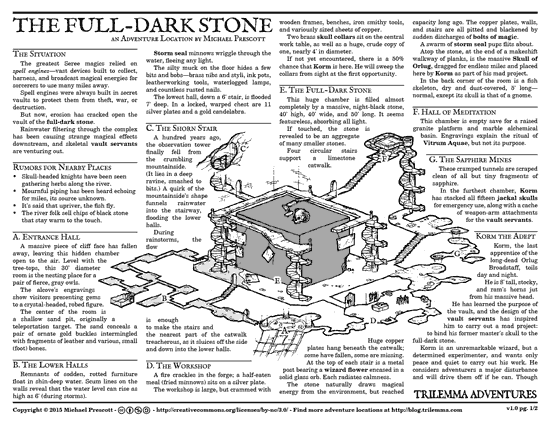
The Full-Dark Stone

Great as they were, the Seree wizards of old would never have been able to cast their most powerful magics using talent alone. Still lying around the realm are their spell vaults, tomb-like fortifications that hold the secrets of their magical supremacy.

The Seree are gone, but the vaults remain. But the gnawing of time cares nothing for secrets..


On the big map, the vault is located in the foothills of the Wintpeaks, north of Aridenn, but you could situate it in any mountain or escarpment. Relatively close to an existing settlement is better, since that gives a greater chance that there are some 'river people' encountering the vault servants, or exhibiting odd, magical side-effects from the vault's runoff water.

There's very little loose treasure in the vault, but remember that nearly every skull contains a wizard flower!

Vitrum Aquae for Player Characters

If PC spellcasters experiment with the vitrum aquae ritual, it's basically an opportunity for a permanently-memorized spell (which uses up the spell memorization slot), at the cost of a point of one or all of Int, Wis, Cha.

The quantity and quality of gemstone should be commensurate with the level of the spell being crystallized - anything less will worsen the side effects, which include:
  • Losing more points from Int, Wis or Cha
  • The spell uses up one or more additional spell slots
  • The spell is miscast, and can never again be cast in its correct form, and always comes with either minor or major side effects (e.g. fireball always detonates at the wizard's fingertip, invisibility can only be cast on someone else, levitation only works upwards, the wizard can never fly to the east, etc.)

Art Files

Thanks again to everyone supporting this project on Patreon! Thanks to their generosity, everything in the adventure is released under cc-by-nc, so you can pull it apart and remix it for whatever non-commercial purpose strikes your fancy.

Tuesday, 22 September 2015

Making a 3D Map, Part 1

I'm doing another 3D map for Bedrock Games, and figured I'd show the process I'm using here.

As usual when I do maps for +Brendan Davis, he showers me with sketches, documentation and reference images to help me out. It can be a lot to read at times, but it comes in handy when doing 'dungeon dressing'.

In this case, we're doing the Tomb of the Timeless Master, an adventure location for the upcoming Wandering Heroes of Ogre Gate wuxia RPG. It's got a lot of vertical elements - great for isometric or other 3D maps.

Here's part of the sketch Brendan sent me:


After a bit of back and forth, I knew the altitude of everything, which way the stairs climbed and so on, so I could start thinking about one of the big challenges of doing a 3D map: which angle do you pick to draw it from?

Sometimes you're rendering a location that follows Q*Bert topology. That makes the decision easy: you draw the dungeon from the angle that makes it more or less co-planar with the surface of the paper.

3D Maquettes to the Rescue

Some dungeons just aren't that simple, however, and the Tomb of the Timeless Master is one of them. After staring at it for a while, I realized the only way I was going to figure it out was to play with an actual 3D model of the dungeon.  Time to bust out SketchUp!

One of the great features of SketchUp is that you can import a 2D image to use as a reference. Below, you can see Brendan's original sketch.  I've traced the rooms, then lifted them vertically to the correct height.  Before long, I had a little 3D maquette to experiment with.


This let me rotate the model this way and that, looking for the angle that presents the dungeon in an interesting way, and with the least number overlapping elements. Some more discussion with Brendan helped here, as he decided to collapse a few stray bits to help it read as clearly as possible.

Cyan Is Your Friend

How to get from here to an illustration? I like to draw at an exaggerated scale, because that helps with the detail. Unfortunately I only have a letter-width printer and scanner.  I decided to do what I did on a previous illustration: to draw it piecemeal, and assemble it digitally.

To this end, I needed a template to make sure that all the pieces fit together properly.  The basic idea is this: print out a reference in non-photocopy blue, draw it, scan it in again, and pull out the blue using Photoshop, leaving a clean illustration for me to assemble.

With a few tweaks to my SketchUp settings, then a bit of adjusting in Photoshop, I had my template.


As you might be able to tell, I've actually decided to go with a 3D perspective rendering, not isometric at all. SketchUp makes this easy, and 

Working as a mosaic, however, means stitching together pieces of the illustration. Fortunately, the same technique I'm using for the template can work here, too. Where the pieces need to overlap, I can actually just print out the "seams" in blue, connect them by hand, and scan them in again.

Pull out the blue and I'm left with just the new, hand-drawn connection piece (in black), which fits like a puzzle piece with the two halves of the illustration I'm connecting:


Above, you can see part of the chapter heading illustration from the same book. This image appears in a few variations, which required me to join up a few "alternate" pieces of the illustration.  The woman on the left appears in two different poses, but she needs to connect to the same piece of scarf.

Stay tuned, I'll post the map once it's done!

Monday, 3 August 2015

Torchbearer

Some time ago I got a chance to playtest Torchbearer, and it forever changed how I view dungeon crawls.

Torchbearer takes encumbrance, light and hunger and makes them chunky enough to use all the time, and then makes them central to game play.

The net effect is that dungeoneering feels like spelunking or even scuba diving: a descent into a place that is inherently hostile to human life, and where a misplaced tinder box or a torn backpack can mean the difference between a comfortable trip home and a harrowing tale of survival.


The core of gameplay is the same as many other RPGs, the players say what they're doing until the GM feels it requires a skill test of some sort. Characters have a bunch of skills (e.g. Fighting 3, Cooking 2, etc.) which tell you how many d6 to roll. If you roll enough 'successes' (4-6 on the d6), you've made it.

This happens inside 'the grind', the steady wearing away of the characters' resources. Every meaningful action the party carries out takes a turn. Torches last 2 turns, lanterns 4, and every four turns the gnawing of hunger worsens. If you have food or water to eat, great, otherwise you start earning Conditions.

Characters don't have hit points. Instead, injuries, bruises and all manner of mishaps are represented by conditions: Hungry, Angry, Afraid, Exhausted, Injured, Sick, Dead. Most of these come with mechanical penalties. Unlike the 1hp fighter who's basically fine, a Torchbearer character with a lot of conditions feels like a half-crushed insect crawling for cover. A badly roughed up party is a sorry thing indeed.

One tool the characters have to help with time is their Instincts. Each character gets one, an instinctual action they automatically take without having to coordinate with the others. The thief's might be, 'Always probe the ground ahead for traps,' while another character might have, 'Whenever we camp, make poultices for the injured'. Instincts don't take up a turn to carry out, so a party with well-chosen instincts feels like a well-oiled machine.

Overlaid on top of this is a large-scale turn sequence, divided into "phases". In the Adventure Phase, characters explore, fight, disarm traps, haul loot, and so on. By expressing their characters' flaws in various ways, they earn 'checks', a sort of metagame resource that allows them to camp - where they can rest, recharge spells, try to deal with their wounds and ailments, make preparations. The number of checks you earn limits the amount of stuff you can get done in camp.

This is one of a couple of places where the system isn't trying to be naturalistic, to 'get out of the way' and help you resolve situations 'that would occur', it's definitely trying to make situations occur. Going with the flow involves treating this like another tactical challenge to be mastered: when do we camp? Which tests can be we afford to blow so we can earn some checks?

Instincts are part of this. Our playtest group wound up with a lot of camp-related instincts, which was awesome: the moment we decided to camp, everyone knew exactly what we all needed to do.
This brings me to skills, one of my favorite parts of the game. Torchbearer skills form a well-designed little knot of mechanics, each referring to one another through hidden economies that make them all useful. During character creation for our second playtest party, we were actually looking around to make sure someone had Cooking skill - it's that important.

"Fine, I'll go back to look for the cooking pot."
Combat is handled using the 'Conflict' mechanic, a generalized procedure for resolving complicated situations like fights, an escape through a labyrinth, bargaining for one's life with trolls, and so on. Conflict is pretty neat, but I have mixed feelings about it.

All conflicts have a goal, which is awesome - before any fight, for example, the party has to decide what they want. Are they merely trying to drive off the stirges, or actually kill them? Or is the party trying to get away, using violence as a deterrent to pursuit? This determines what's at stake. If you're fighting to drive off the enemy you're risking serious injury and there's an off chance someone might die, but if you're really surging forward to do fatal battle, death is on the line for everyone.

Conflict resolution is handled by comparing a script of three secretly chosen actions: Attack, Maneuver, Defend, or Feint, each of which has a lead character, round robin style. (Our side's script might be Wallen Attacks with his sword, Bortle Defends by casting Shards of the Ancients, followed by Zebulba Attacking with his bow.)

As you reveal actions, they interact with the enemy's choice, and ultimately do 'damage' to each side's 'disposition', a number representing the quality of their tactical position. Attack reduces the other side's disposition, Defend improves yours, for example.

Weapons interact with this in neat ways - mutual Attack is a brutal melee that does massive damage to both sides, unless one side has bows, in which case it's turned into an opposed roll. (Always have bows.)

When one side hits zero, the conflict is over - the winner's remaining disposition determines how bad it is for them. Beating an enemy without taking damage means your team's in great shape and wins without compromise. Winning with only a point or two left feels a lot like losing.

This leads to some extremely tense moments. My players were trapped by a pack of crypt servants, and had to decide whether to try to drive them off, which is hard to do to unthinking undead, or kill them - easier, but exposes them to fatal injury. They opted for the latter, and toward the end of the fight found themselves winning but having lost a ton of disposition. This meant certain death for several of the party members, so there was a desperate last-minute attempt to weave in some Defends to prolong the fight, to secure a better position to try to save everyone.

This is awesome, but always a little abstract. This isn't a system where you lobby for an advantage for fighting from the staircase, it's a system where you script Maneuver and then characterize your maneuver as the clever use of the staircase. It's a subtle difference that requires you to direct your cleverness into the tactical minigame rather than clever use of the environment as described. If you roll with it, you get a fun tactical game; if you fight it, it chafes.

Because the GM assigns conditions based on the final disposition score, this can occasionally put the GM in the position of deciding which character(s) should die.  I tend to prefer a bit more support from the system for such brutal turns of events.

As a GM, running Torchbearer was quite eye-opening, in two ways. First of all, there is so much player-to-player conversation about the tactics and logistics of the situation. In some systems (e.g. Dungeon World), logistics become a problem when it's awesome for them to be. It's as if a narrator is saying, "On this episode, the adventurers find they're short of food.."

In Torchbearer, this sort of thing emerges from the mechanics, and so the players are the first to know.

The players know how much food they've got, they know that the fighter is hampered because he's carrying a torch as well as his sword, so the wizard has to carry the large sack in both hands, which means he can't climb the rope. They're aware of the constraints, the risks and their options, so there's a constant stream of player-to-player planning, querying, and planning, whenever a novel situation presents itself, which is music to my ears.

The consequence of this, however, is that the GM isn't fully in control of the danger level. This really blew my mind.

It's okay, we're leaving!

The constant question for a Torchbearer party is this: should we go on? If we do, will we die? Or, if we don't die, will we be so badly hurt that we can't easily survive the return journey? Have we already passed that point?

Once the party has climbed down a natural limestone curtain, crawled through a tunnel half-filled with ice water, and taken a beating while fighting some kobolds, they might already be dead.

The accumulated dangers from having to get past those obstacles, each of which has an established danger, might already be enough to kill them. This can really sneak up on you, and the sense that you're starting a downward spiral from which you might never pull out is tangible at all times.

The party, and the mechanics of injury, conflict, conditions, time and light is like a Rube Goldberg machine - you put challenges, danger and adversity in, and it might not be until half an hour later that you realize the dose was lethal.

Even between adventures there's no relief!

Adventurers are by definition dirty outcasts with no social standing, and this means that any time they're in town they're facing extortionate bills for everything - accommodations, food, replacement gear, healing, research. The speed of business is slow in dark ages fantasy, so nearly everything you try to do jacks up the difficulty of a lifestyle test. It's another kind of grind!

Adventurers are caught on a treadmill of poverty, injury, and exhaustion.. until they either manage to catch a break, or die.

The one thing you always keep is your improved skills. If you can survive, you'll inevitably improve.

(Note: I was a playtester for Torchbearer, and contributed a few pieces of interior art.)

Thursday, 30 July 2015

Night's Black Agents - House Rules

Tonight we concluded our Night's Black Agents campaign.  We finally figured out to consistently do damage in the combat system.  MP5 with a tight burst to the head, a fat 12- or 13-point spend will do nicely. On a lucky roll you can even one-shot a vampire!

It's a good strategy, because vampires can cause so much chaos and damage you really don't want them surviving into round 3. Killing them in round 1 is ideal!


Tonight's climactic fight finale was two vampires and half a dozen Renfields, which looked like it could slide into a TPK at any minute, despite us coming extremely well prepared - thermobaric grenade to start things off, MP5 headshot, then supporting fire from an army surplus flamethrower.

(Flamethrowers are cheaty awesomeness in this game. Never leave your car without one.)

On the other hand, "Shock and Awe" tends to leave you with very few points to mop up the mooks, which turns the fight into unintentional comedy.  The mooks, too, start to run out of points, so the fight system almost does the opposite of what you want, steadily decreasing tension as everyone's attacks get less and less effective, like exhausted boxers circling one another but unable to land solid hits.

"I can't pick it up for 24 hours."
That and melee weapons (so far as we can tell) just suck compared to firearms.  You risk facing lethal damage from stand your ground when you close if your target still has a gun, and once you get there you need to have vast amount of points and pray for a critical - there's no special ammunition to boost damage, no laser sights to boost accuracy, no auto-fire for cheap extra hits.

Spending Preparedness to whip out a concussion grenade and throw it with Athletics is way more effective.

Upping the Ante

I propose three house rules to up the ante, and keep fights nail-biting until the final mook falls.

1. Unforgiven: By exposing yourself to enemy fire to take careful aim, disregarding the danger, you can spend Stability as Shooting.  You can sweat out your suicidal tendencies when you get back to your motel room.

2. Pulling a Muscle: By digging deep and straining your body to make a heroic effort, you can spend Health as Weapons, Hand-to-Hand or Athletics.

3. Multiple Stab Wounds: If you land a hit with a knife or dagger or other nasty, close-quarters weapon, you can treat it like a fully automatic weapon, but you spend Stability instead of Weapons on the extra damage dice. Stabbity stab stab, you psycho.

Tuesday, 28 July 2015

Quick & Dirty AW-Style Character Art

One of Apocalypse World's iconic features is the stark, black and white character art in each playbook.

There are lots of ways to produce this sort of stuff, some requiring more talent than others, but here's is a relatively low-skill way to use Photoshop to producing vaguely similar-looking images.

(One of the things I like about it is that, with the exception of one step, it's all dynamic. I'm a big fan of adjustable, reversible steps that I can come back and tweak later. Running a series of filters and baking it all into a single layer just feels wrong to me.)

First, find a suitable original photo (which you have rights to, obv.). This is just a photo I snagged off the web, which means this man will presumably track me down and kill me at some point.


Chuck this into Photoshop, as the bottom layer.  Above it, add a Threshold Adjustment Layer, which will make the image look like this:


Tweak the threshold value (from 0-255) until you find a setting that you like.

One thing you'll notice is that (depending on your source photo), you may be looking at a lot of detail, with little 'crumbs' everywhere.  A simple way to chop this down is to make a copy of your photo (above the original) and then use the Gaussian Blur filter.

With the blur filter's preview feature turned on, you can see the effect it'll have on your image before you commit. (This is the one non-dynamic step in this process.)


Next, I chop out the unnecessary background with white. There's lots of ways to do this, but I like a Solid Color Adjustment Layer, using the alpha mask to control where it goes.  (I used the magnetic lasso selection tool to build the alpha mask, for the most part, but simply painting white or black on a layer above the source photo works fine too.)


Now, this is okay, but while a lot of the detail is good, his outline has been lost. To selectively control the threshold in parts of the picture, I use a paint layer to adjust it:

Underneath the white mask, insert a new layer, called 'Adjustment Paint'. Set it to 50% Opacity, and set the blend mode to Overlay. (Overlay can be used to both brighten and darken areas in the layers below.)

Painting black or white on this layer (I use a pressure-sensitive brush, but setting your brush opacity to 30% will do more or less the same thing if you're using a mouse.)

Paint black where you want more black in your final image, and white where you want more white. This lets you tweak parts of the picture to control, essentially letting you change the threshold value in specific areas of your image.

This is the adjustment paint layer over the original photo for illustrative purposes: I actually paint with the threshold filter on so I can see how it looks in real time. Yay adjustment layers!


As you can see, this adjustment layer can be really sloppy. As long as it's under the white mask, it's okay to paint into the background.

 I chose to darken his outline to make him look a bit more solid against the white; I darkened his gun but left his gloves and face fairly light.

This is the final image, about ten minutes' work in total:


Of course, you can do much more work - it still looks very photographic, and the sleeves in particular are all kinda crinkly. To take it further, you can hand-paint final details over the Threshold, using this approach as an 80/20 starting point.

Here, just for kicks, I've chosen a slightly lower threshold point to make it darker, adjust-painted the face back up, then put a black stroke around the white mask for a slightly more cartoon, cut-out look:


For reference, this is my final layer arrangement: