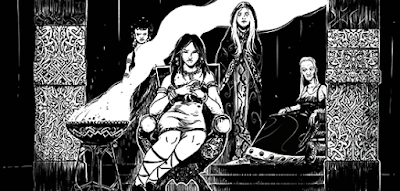
This is me thinking out loud about intrigue in role-playing games, and a bit of scaffolding to make it happen. For the moment I'm thinking about this like a world builder, a would-be GM setting up a situation suitable for political intrigue.
What I've got is:
- overt violence is impractical (or extremely costly)
- several (or many) factions competing for dominance in a cooperative endeavour
- power is divided among the factions
- factions want more than one thing
- strengths and weaknesses tie the factions together
Costly Violence
For intrigue to happen, you need multiple factions in a context where overt violence is impractical (disastrous, strongly discouraged, or incredibly expensive).
This could be the fact that escalation is bad for everyone. In the cold war, any direct military conflict between the superpowers could have escalated into a world-destroying nuclear exchange, so conflict had to be indirect, covert, deniable, or all three.
There may be a faction that has a monopoly on violence or overwhelming military power, but deploying it might be incredibly expensive. Crushing enemies might just make more enemies; troops must be paid; debts must be cashed in; the obligations of vassals might only be usable once. There may be no way to carry out violence without overwhelming retribution.
Another possible brake on escalation is when there are many factions that are competing for dominance over a cooperative endeavour. The realm is more prosperous when the barons are trading instead of warring. They are unequal in power and one of them will be king, but no one baron is strong enough to take the crown by force without the support of many others.
In this kind of situation, there may be rules that govern the transfer or power: heredity, etiquette, oaths, contracts, traditions, or rituals. The rules protect the factions from the disastrous costs of conflict. Even if there's no open violence, a winning coalition might decide that everyone who supported the losing side needs to be punished, stripped of its assets, or stamped out completely.
Therefore, anyone who opposes a strong coalition publicly must resist in legitimate ways. Their opposition is merely part of a system of time honoured checks and balances, challenges which are rightfully protected by tradition. Anyone who resists the eventual winner in illegitimate ways risks being branded a traitor, a rebel, a conspirator who opposes not just a contender but society itself. Anyone who does this can be legitimately stripped of their freedom, power, and wealth. Any non-legitimate actions must either be indirect, covert, or deniable.
Competition Within a Cooperative Endeavour
I mentioned this above, but the cooperative endeavour could be any context that none of the factions are willing to destroy. It could be the functioning of a city, the belief in the rule of law, a planetary ecosystem that won't support them fighting.
It needs to be constricting enough that they can't simply go their own ways. They're stuck together in the same planet, realm, city, or lifeboat and they share its fate.
Power is Divided
At the same time, no one faction can be so powerful that it dominates the others outright. Each faction's power is incomplete. Each must have only a few pieces of the puzzle, however outwardly strong they seem. If any one faction is so strong that it holds all the cards in any negotiation, this limits the options for intrigue.
Factions Want More Than One Thing
Years ago I was listening to some tips on negotiation; it made the point that once you pin down your negotiation to everything but the price, you're fucked. Now it's just a straight tug of war, and any change in terms will have a clear winner and a clear loser.
The answer was to find a meaningful trade-off, two dimensions where the parties have different preferences. In contract negotiation this could be around payment terms (a higher price is fine, but I want 90 days to pay; a lower price is fine if you pay in cash, etc.), but it could be anything.
You can run around town intimidating people, or doing covert actions to undermine another faction's power, but for there to be political negotiation (not just flexing and cowering), factions need to want more than one thing.
A nice way of illustrating this is the indivisible prize. You want the crown, so do all the other barons. There's no way you can get it without their support, but crowns can't be shared. Obviously you'll need to find something they want that isn't the crown to exchange for their support.
Splitting Up Power: Internal Cracks
I can think of a few simple ways to pull off two of these things at once, making a faction's power incomplete while making it want multiple things.
One is to make its leadership divided. Sure, the ruling family of the East Barony is all in it together, but that headstrong uncle is hoping for a martial victory, while the cruel baroness mostly cares about sticking it to the Gellish. Clever negotiators might find ways to play on the power dynamic between the two.
Similarly, you can always break a faction into multiple sub-factions. The baron wants the crown; the advisors think the baron's son has the best chance and the baron might be overplaying his hand to try for it himself. The baron's financiers want their loans repaid, and want to discourage the baron from hiring expensive mercenaries if there are soft power approaches to be taken instead.
Divisions can be found at any scale. The baron's court has a doorman who resents the regular visitors; the kitchen staff are looking forward to cooking for a king and don't mind who knows it, and so on.
The other mine for internal cracks is how a faction maintains its material conditions. Just surviving, growing food, the clanking and sloshing of industry is a lot of work and takes numerous people with different needs and opinions. A barony that has grown rich on wool exports might be full of internal divisions between land owners, tenant farmers, bandits, wealthy and poor.
What compromises have been made to achieve the focus the leaders want? What's running out or not working well? What resentments or disagreements are starting to build up?
(EDIT: At the risk of stating the obvious, you never 'negotiate with a faction', and factions don't want things, they're made of people who want things. Personifying the faction as an NPC is much more characterful than a completely unified front of interchangeable negotiators. The point of this business about finding internal cracks is not so you wind up negotiating with ever more microscopic factions, but that there is always a way to find some leverage.)
Splitting Up Power: Different Strengths
Another way to make faction power incomplete and give yourself some surface area to invent multiple goals is to divide up different kinds of power between the factions.
Consider:
- Who has society's material wealth?
- Who makes society's decisions?
- Who controls society's ceremonies and proceedings?
- Who has society's cultural biases or ideas of legitimacy in their favour?
- Who is well regarded and influential?
- Who knows more than the others?
- Who is able to conspire and coordinate most freely?
- Who is organized and able to act decisively in cohesion with their supporters?
- Who has strong ties of loyalty?
- Who benefits from the biases inherent in the institutions?
Each faction might have strengths in one or more of these areas, but weaknesses in others. For example, imagine a general with a reputation as a war hero, made rich by foreign spoils and plunder. Unfortunately, she is viewed as a commoner with the least legitimate claim to the crown, and by virtue of her military rank is forbidden from even entering the Rotunda.
To play to her strengths, she wants to exaggerate external threats to the capital to give herself more latitude to operate politically. Even better, forcing other houses to have to pony up money for costly troops would stretch them thin. However, she's desperate for some kind of cultural legitimacy—perhaps by marriage or false historical record. She also sorely needs eyes and ears within the Rotunda so she can stay ahead of the senators' plans.
Don't overlook the challenges and advantages involved just in communication and alignment. Some English king or other apparently tried to ban jousting tournaments, because these gave his barons opportunities to get together and plot against him. Sending one-to-one messages back and forth takes time, and in politics, an advantage over the means to coordinate is a huge advantage.
Similarly, having a responsibility for administering the ceremonies and proceedings may not give you any official power. You're just supposed to bless the marriages. But that gives you all sorts of ways to control the amount of friction everyone experiences. You can speed things along or drag things out on technicalities. You may have complete access to venues that might otherwise be secured against intrusion. Being the only faction able to find a quiet side chamber away from prying eyes during a tense summit might make all the difference.
Random Faction Strengths
To keep things surprising, let's use that strength/weakness list as a random table. Each major faction gets one strength and (to make sure their power is incomplete) two weaknesses.
| Roll d10 | Strength/Weakness |
| Material wealth |
| Decision-making power |
| Control over ceremonies, proceedings, venues |
| Cultural biases and legitimacy |
| Influence and reputation |
| Knows more than the others |
| Freedom to conspire and coordinate |
| Organization, cohesion |
| Ties of loyalty |
| Institutional biases |
Trying this out with a very small sub-faction, the court doorman I mentioned earlier. A strength and two weaknesses:
- Strength: (2) Decision-making power. Curlis, master of the door, can choose who to admit and who is refused.
- Weakness: (7) Freedom to conspire and coordinate. Curlis is always observed, and despite his strong opinions and his position of influence, has limited ability to benefit from this power (e.g. via bribes).
- Weakness: (6) Knowledge. Despite directly seeing the comings and goings to the court chamber, Curlis stands outside it and has only conjecture to go on about what dealings are taking place.
(That's pretty funny, an NPC with power who is dying to abuse it but can't find an opportunity that would benefit him.)
Tying Factions Together
Each of these strengths and weaknesses can be used to tie the factions to one another. Pick one, and pick another faction, then roll to see how the power imbalance plays out in their relationship:
| Roll d6 | Strength/weakness tie |
| A brutal choke hold |
| A coercive power imbalance |
| A sense of duty |
| A delicate alliance |
| Repaying a debt |
| Benefits shared freely out of love or loyalty |
- Curlis's decision-making power ties him to, um, the baron out of (6) love or loyalty. He's glad to serve the baron faithfully and keep out those he thinks are bad for the court.
- Curlis's inability to conspire or coordinate ties him to the court advisors, out of (3) a sense of duty. All his communications with the outside world flow through them, and he abides by this out of a solemn duty to remain impartial.
- Curlis's lack of knowledge of the political landscape ties him to the baron's financiers in (1) a brutal choke hold. He is completely suborned by them, and keeps out anyone that the financiers think might influence the baron to spend any further before repaying his debts.
This is just me experimenting; for a tiny "faction" like Curlis (or perhaps the entire palace guard) probably one is plenty. A more potent faction (like the baron's noble house) could have three or more.
In Play
So far I've been talking from a world building perspective, as if you were going to plan out all these factions ahead of time. I don't think that's necessary, and probably not even a good idea. Tim Groth put it aptly, "World building is a misnomer, it is really just set building."
The key thing players need in order to engage politically is to understand the landscape to be able to make informed choices. Where do they apply pressure? What asymmetry can they exploit?
To avoid the info dump problem, I'd recommend rolling all of this as late as you possibly can. If you can roll and brainstorm on the fly, great. You can also get your players to declare their goals to telegraph what they're up to, so that you can do a bit of thinking between sessions.
Achieving Political Goals
Here's a super simplistic theory of political action, just truthy enough to structure a campaign:
To achieve a political goal, you must negotiate (or conduct covert action) to achieve all ten strengths.
Everyone wants something; you want the crown. By negotiating with everyone, you help them achieve their different, disparate goals in return for their help with your singular, focused goal.
The easiest way to put this into practice is to create a patron with a political goal, and to have the PCs be fixers/ambassadors/negotiators. The patron knows the 'campaign structure', and can simply present a handful of relevant facts as the starting context.
- (Wealth) The baron is struggling with debt. A bid for the throne is expensive, who will fund this?
- (Decision-making) House Otherhouse controls the council of barons, which by tradition chooses the king in times of the line being disrupted. We have no sway with Otherhouse right now.
- The church conducts the coronations and must bless the transfer. Will they?
- (Coordination) The barony is large, but on the periphery of the realm. Who can be trusted to host the necessary meetings to mobilize support?
- (Knowledge) What other schemes are afoot that might derail this? Who else is mobilizing supporters?
And so on. Every weakness is an opportunity to negotiate with a potential supporter to shore it up. Every strength is a temporary advantage that may require defending.
What Do Players Do?
If the players have an ambitious patron with a political goal, what should they tell the PCs to do? If it's a more player-directed campaign (e.g. perhaps the players are running a faction themselves), what are some constructive ways to start doing stuff?
When you're just starting:
- Scope out the political landscape. Who wants what? What are the factions being public about?
- Scope out a faction's strengths and weaknesses
- Reinforce a strength. Can they take the status quo for granted, or are there new threats?
- Figure out who might be in a position to shore up one of your weaknesses
- Assess a rival's base of power
- Scope out one faction's hold over another
When you're digging in a little more:
- Scope out a faction's internal cracks, the sub-factions and what they might want.
- Apply pressure on allies to commit
- Negotiate, make blunt offers
- Act to weaken, undermine, or delegitimize a rival's strength
- Undo or undermine a relationship between your rivals
- Take covert actions to learn or change what you can't reach openly
- Test boundaries to learn the real limits of your influence
When it gets to the finish line:
- Offer last chances to rivals
- Take bold covert actions
- Make your schemes overt, bring on the final showdown and find out who really stands with you
This is just a list of starters, and it's necessarily a bit abstract. "How to intrigue" is a big topic, this list completely ignores all the betrayals, feints, and "plans within plans" that you might get up to.
Final Thoughts
Thanks to Tim Groth and Sean Winslow for giving all this a once over and providing useful feedback.
Tim makes the great point that it matters a lot whether the PCs are the ones doing the legwork or the ones pulling the strings. My gut tells me that if you're using a game that has some supports for intrigue, it's a lot easier to put the players in charge to start with.
Burning Wheel has useful mechanics like Duel of Wits and (especially) Circles and Wises, which give the players lots of latitude in coming up with cool approaches to take without having mainlined a setting bible. Games like
The Sword, The Crown, and the Unspeakable Power have strong archetypal characters, and work almost like a pre-built play set so a group can just step into the roles of very powerful people.
For games that aren't using anything like that, my sense is it might be easiest to set up the PCs as key functionaries first, until the campaign has enough miles under its belt that the players have enough information to form their own goals and strategies.