Monday, 13 November 2023

The Isle of Wight: Zombie Survival

A few weeks ago, I kicked off a zombie survival game set in the real-world Isle of Wight. It's been really delightful!


The campaign pitch goes like this:

On November 4, 1988, a unexpected nuclear exchange takes place across western Europe. The cargo ship BF Fortaleza is travelling unloaded from Lisbon, Portugal to Bournemouth UK when the night horizon lights up with flashes. In the confusion, the ship runs aground on a sand bar off the coast of the Isle of Wight.

With no rescue coming, the crew of 27 shelters on the crippled container ship as winter sets in, glued to the radio for hopeful news. In December, news comes of a mysterious infection sweeping through the cities, with unbelievable reports of people taken by an intense fever and then eating each other.

In January, the UK provisional authority declares mainland cities uninhabitable, and broad-casts an instruction to stop sheltering in place and to flee to sparsely unpopulated areas by any means necessary. Signals from people become infrequent.

In February, the automated radio messages fall silent.

It is March, 1989, five weeks since the last human voice came over the radio. The ship’s supplies will last only a few weeks longer. Reluctantly, the captain asks for volunteers to explore the Isle of Wight, in the hopes of finding other people still alive and the means of long-term survival.

* * *

I'm running the game as a more-or-less West Marches style, in the sense that it's an open sandbox with the players dropping in as they're able. There's a compelling event that gets things going (the home base is running out of food), but other than that there's

I'm trying to run with old school sandbox sensibilities. This isn't a well worn groove for me, I'm very used to trying to maneuver hard to produce a satisfying outcome for each session, avoiding duds at all costs. But I'm letting myself off that hook and instead going with a what would happen? refereeing style.

This can produce sessions that are just so-so, dramatically, but there's a long-term build-up that happens when the world and the events of the game don't conform to dramatic logic, and instead accumulate a sort of stubborn tangibility.

I've written about this before, but the principles of this could be summarized as:

  1. The GM (and/or the rules) creates an environment with hard edges
  2. Players respond by balancing risk/reward, and by inventing solutions
  3. Poignancy emerges over the long term
  4. The design challenge is to help players understand the reality of the situation efficiently, so they can get on with responding to it in the knowledge that their planning effort is worth it

System

For a system, I'm using a kit-bashed homegrown system I'm just calling 'Isle of Wight'. The aesthetics are deliberately old school, but it's very much a hybrid of a lot of things:
  • levels and xp-for-gold, except the rewards are for survivors, medicine and food
  • old school saving throws to help set the mood
  • core resolution is a sort of PbtA-i-fied Blades in the Dark - roll 2d6, but against three grades of difficulty
  • The Regiment style encounter rolls (so good)
  • Blades-style stress meter, but powered by sleep and food
  • Pits & Perils-inspired inventory with super simplistic encumbrance
  • the table-order initiative with interrupts I used in ALM


At some point soon I'll write about how I'm planning this campaign, which held some surprises for me!

Saturday, 11 November 2023

Do Not Anger the Gods

When the servants of the gods fight, they use more than earthly wood and steel. Taking a blow from them can have strange consequences.

d12 Legendary Critical Hit
  Target knocked unconscious for d6 minutes, slammed into 3d6 years of an alternate life of quiet contemplation and service to the being they were just fighting.
  A mighty blow breaks the target's forearm. d6 musical instruments within a league of here also break. Any song or music played within sight of this spot sounds melancholy and out of tune, and brings misfortune (-1 to all rolls) to anyone hearing it for the remainder of the day.
  The target's name is now a curse. Anyone who hears, reads or utters it suffers -1 to all rolls for the remainder of the day.
  The attack causes a deep gash that never fully heals. Every few minutes, a drop of blood falls. As it touches the ground, it sprouts into a delicate, white flower. If the petals are boiled into a tea, whoever drinks them knows what the target was doing in the moment when the droplet fell.
  Weapon impales the target. It is part of them now, as much as the bones in their body.
  Eldritch strike kills the target's dream body. They may no longer sleep. If they try, their empty body rises, possessed for d4 hours. Roll d6 to determine the possessing entity. On a 1-2, a harmless and playful wisp. 3-4, a harbinger of the being that dealt the blow. 5-6, an infernal spirit that lies and taunts.
  Cratering blow knocks the target flat on their back. A hole opens up in the ground, d6-1 paces from the target. Earth and stone crumble away, widening it by ten feet per year, and deepening by thirty. This continues until the target dies.
  A fearsome, life-ending blow misses the target by a hair. Even so, the psychic wake of the attack is so devastating that it symbolically kills the target. From this moment on, no one remembers anything the target says or does. To the rest of the world, it is as if they have died.
  The target is unharmed, but a distant loved one dies instantly. For the next year, any damage done to the target by any enemy doesn't harm them, but harms a friend, ally, or loved one instead.
  The blow splits the target into two halves, which live on separately. Roll d6. On a 1-2 the separate piece is the head, shoulder and one arm. On a 3-4, top and bottom half. On a 5-6, a split down the middle, from head to groin.
  Astral strike alchemically inverts the target. Their clothes and armor turn to flesh: this is now the target's real body, wrapped around a body-shaped sculpture of leather, metal and wood.
  Weapon strikes the target's sternum, shattering their rib cage. Knife-like bone darts shoot in every direction, causing d6 damage to all who fail a save vs. dragon breath. The target must choose: live on as a ribless human worm, or expire in a shower of innards.


Saturday, 4 November 2023

A Patterned Magic

Here's a mini-game for a wizard player, designed to encourage tinkering between sessions in a way that emulates downtime magical research.

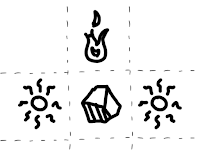
Imagine a sudoku board with astrological symbols, which corresponds to the pattern of the wizard's preparations and meditations.

Certain tetris-like shapes of specific symbols are how wizards memorize spells. e.g. Fire over Earth with a Sun on both sides of the Earth is the Smiting Fire spell. If that's placed anywhere on the pattern between sessions, Smiting Fire is memorized.

Smiting Fire

Great Patterns

The GM prepares five or so Great Patterns, completed boards which each correspond to the ultimate expression of a particular divine imprint on the world, ancient unholy covenant, or the most secret teachings of a long-lost school of magic. In addition to the memorized spells, the more of the board that matches a specific Great Pattern adds different effects. (If you unwittingly include the shape for Drenzel's Eye, orcs will always find you, etc.)

There are also basic, sudoku-like rules. It's not good to have more than one of the same rune in any given 3x3 'house', for example. The the more rules you break, the higher the chance of spell failure or wacky outcome.

A small pattern containing 6 different spells

Newer wizards can always leave large parts of the pattern blank for safety's sake, or only bear smaller patterns less than full 9x9 size. Wizards bearing patterns with more than a dozen runes radiate faint magic to those who can see; wizards with completed, full-size patterns are psychically radiant, crackling with otherworldly sparks and eddies that tumble from their hair and fingers.

Advancing

Wizards advance in a few ways: Fragments of these boards are scattered throughout the campaign world.. a strip of runes on an altar, a 3x3 embroidered on the lich's frayed shroud, a dusty tome of mad scrawlings.

Sometimes it's a literal spell, sometimes it's just a part of a Great Pattern, or perhaps just a clue. ("The great meditation of Deel wants not for fire in the upper houses, and thrice Water.")

A wizard's meditation pattern can be changed in play, but this is usually a solo activity done between sessions. (It takes a game hour of time to change one rune if it does happen in play.)

Another way to advance is magical research. If a wizard has a month of downtime, they can submit a pattern of whatever level of completion to the GM. They make a research roll, modified by the money they spend, the time and the quality of their sanctum.

Based on their research success, the GM will reveal one or more clues, complete spells, or matching parts of a Great Pattern in the wizard's submission. (This could be a useful discovery, or perhaps something to avoid at all costs.)

Another way to learn more magic is to watch another wizard perform it. When encountering either instructive, helpful, or antagonistic wizards using magic, there is a chance for the player wizard to discern a fragment of the meditation in use.

A Magical Minigame

The point of all this is to give wizard players a minigame that feels a little bit like actual magical research. Bring the arcane arrangement of runes and symbols into between session play.

The 'minigame' is the tinkering with the patterns, taking all the scraps and clues of what the party has learned and trying to make the best pattern they can. What if that altar was actually to Deel, and the strip of runes we saw there does belong in the void pattern? How do I sandwich all eleven spells I know without having all those pesky suns fry me alive every time I cast a spell? Do I fully commit to the Great Pattern of Deel, or do I try to bash in a few of those handy Sorgite curses in the bottom row?

Some Assembly Required

This of course only works if the GM is ready to prep a few things, giving runic patterns to all the spells, creating however many Great Patterns.

Most of all, it all relies on some tool to quickly enter and analyze a player-submitted pattern so the GM can immediately see everything of interest that will affect gameplay.


Saturday, 30 September 2023

A Downtime Calendar

One way to bring a setting's calendar to life is through downtime. When you spend a month cooling your heels and recovering from the road, each month has distinctive, meaty benefits.

Set the list out where the players can get it, and let them make their own choices. It doesn't even matter if players are actually able to make use of the benefits they want. If all that happens is the party lamenting, "Damn, shame we have to travel during Ferch," it's doing its work!

Here's a set of calendar downtime benefits appropriate to the sort of campaign presented in the compendium, scattered communities in a wilderness full of danger. If the party spends the full month engaged in rest or aiding the community, the benefit is theirs!

# Month  Benefit of a full month of downtime
  Anvial Winter's stillness brings clarity. The guide you seek will find you.
  Bolc As the snows subside, old paths need mending. Those who do warden's work are blessed: they will not get lost on the way to their next destination.
  Cindal Spring dawns. Planting time means grudges must be set aside, at least for now. If you seek a favor of someone influential, ask it.
  Ferch Rains reveal what must be repaired. Find the old stones and new and get to stacking.
  Greel In the humid season, if you seek an ally with special skills, you find them. They will aid you, but summer's friend betrays in autumn.
  Halvilary Summer's forges burn hot and true. If you are procuring gear, one item made for you this month is of remarkable sturdiness. It will never fail you.

Juthon Long idle days and warm summer nights are fertile ground for schemers.
  Marial Summer's last light is golden. Rest in it, and all injuries to the body are cured, however severe—but scars, grief and curses are yours to keep.
  Samber Nothing like a month in the fields to cement a bond with the community. Whatever else has come before, you are welcomed as if you were born here.
  Tershon The last of autumn is no time to start a long journey, but those who feast well in Tershon will not grow hungry until they are home once more.
  Nollen The hopeful stand watch over the roads, praying for cold winds to bring lost friends. The steadfast will not be disappointed.
  Rinth In the darkness of winter, secrets slip from cold-numbed hands. Something important kept hidden by the community is revealed to you.

(These rules are MOSAIC Strict.)

Sunday, 3 September 2023

The Fires of Lost Tlarba

A dense and dusty city toils under a flickering yellow sky. None may enter, but everyone does. All may leave, but none do.

Prickly selks stand at the gates. Their halberds gleam like razors, but their eyes are dull from the heat. The crowd inches forward toward the city's mouth.

Sickly smoke rises from the burners along the high walls: a thousand fires of caylum wood, oracle grass, the narcotic feathers of the santhum bird. Travellers cover their mouths and noses, hoping to ward off the stupor that will soon take them. Others breathe it freely in the hopes they will acclimatize. None will.

The crowd moves again, and the gates loom overhead. Everyone who passes them is looking for something. Everything lost winds up in Tlarba, they say, so where better to look? This is why you came, but maybe it was a mistake.

Robed sisters push and weave through the entry line, offering marks of return. "Sixty silver and we'll fetch you out if you're in too long." Ink-black fingers tug at your skin. "Here is best," she says, jabbing at your cheek. "How long do you want? A year? Three?" She isn't joking.

The nut-seller at the side of the road laughs. "Don't waste your money, they can't get out either." He scoops roasted seeds into a folded leaf, "Buy these instead. They won't get you out, but it's best not go in wanting!"

As you reach for them, he catches your sleeve and pulls you close.

"I mean it," he hisses. The humor is gone from his face. "I went in a prince. Choose better!"

He shoves you back into the lineup, laughing once more. Stupid man. Who comes here if they have a better choice?

The crowd moves again, and you pass the gates. Pilgrims, families, warriors, nobles; their mules, horses, dogs and goats. Each enters in their own way, but the sweet smoke claims everyone who draws breath. You're still thinking of the nut-seller's words as it takes you.

* * *

d10 Where You Awaken, d20 weeks later
  A secluded garden terrace, high above the haze of the city. Succulent plants hang from rows of trellis.
  At bend in a narrow, twisting set of stairs. Fresh air somehow blows from a crack in a clay duct.
  In a large stone chamber, apparently beneath a temple. Chanting comes from above. The stone floor below you is warm to the touch.
  Crazily high up, halfway up a cathedral tower. You sit on a stone ledge barely wide enough for the birds. The squares and rectangles of the city spread beneath you endlessly.
  Sitting at the edge of a fountain in a wide, sunlit plaza. The sparking water cools your fingers and clears your mind.
  Lying in soft earth in a walled vegetable garden. Half-eaten gourds surround you; seeds are stuck to your face.
 A public bath house, at the end of a long pool of oily, fragrant water. Bright morning light comes from slats in the ceiling. Smells of cooking waft in from the street outside.
  In a dark servant's passage somewhere in a grand, stone house. A thin shaft of afternoon light comes from a tiny window.
  On a luxurious bed, somewhere in the high palace. A huge silver washing basin stands on spindles of dark wood.  Curtains billow in the cool night breeze. In the courtyard below, servants are lighting lamps along the edge of a dark, shallow pool.
  You stumble on the road leading out of the city. The yawning gates are behind you. Hundreds of people queue to enter as you once did, but they pay you no attention. Roll no more, your time in the city is over. It is d4 years after you entered the city.


d10Context
 Exhausted revelers surround you. Some are sleeping, others quietly chatting or combing each other's hair. All are sweaty from dancing, running, or sex.
 You are pale and sickly. A friend mops the sweat from your brow. The sickest among you is now immune to poison.
 Damp, mildewed air blows from a hole in the ground. You have found a way into the labyrinth beneath the city, the streets and alleys of an earlier era, buried by time and new stone.
 Several families are preparing food, setting out tables with fresh bread, pots of stew, and hot, watery wine. Children light fill lanterns and musicians are assembling to begin the song. Adults speak in quiet tones about the business of the city.
 You and a woman you don't recognize hold opposite ends of a sheaf of scrolls, the collected notes of the high palace locksmith.
 You are covered in small cuts and bruises. At first they hurt terribly, then not at all, and rub off like actor's paint.
 A small gathering of students and poets was listening to what you had to say, and is waiting for you to continue.
 You have been running for your life. Your heart is pounding. In ten seconds, d6 strong youths will arrive to beat you for stealing from them. 
 A guard's knife is bloody in your hands. He lies at your feet.
 You have found whoever or whatever you came for.


d10A bit later, you suddenly remember
 Living with a family for a time, learning their skills, working as part of the family business. When you touch your callused hands, you remember that they loved you.
 Squatting in a temple for months. You learned the names of many animals who lived there. If you see them again, they will remember you.
 Wading through a foul-smelling canal. A youth you had made friends with dallied, and that was the last you saw of them.
 Watching a pack of feral people eating a man who had stumbled in the gutter. They tore at him while he groaned. You remember the taste of him; perhaps you joined them.
 Exchanging clothes with a princeling, who then slipped away into the crowds. You still wear his ring, which marks your station in the city.
 Studying with a monstrous, toad-like philosopher who swore off tools of any kind—not just hand tools, but clothes, dwellings, weapons, books. 'Convenience softens the mind,' it would croak. It is right, and its teachings have unlocked something strange and new within you.
 Fighting your way through a riot in the Plaza of Jewelers. Many had fallen, and the flagstones were slippery with blood of citizens and palace guards. The shouting still rings in your ears. Many enemies were made that day; some on each side will remember you.
 Plotting against an order of priests who jealously protect a magical way out of the city. Your fellow conspirators plan to strike tonight, coming up through the servers. They're relying on you find an open the sewer grate in the Plaza of Tears, or they will all drown as they try to escape.
 Riding with the nut-seller in a royal palanquin. He was dressed like a prince, and proudly pointed out the sights as you passed. A location you sought is now known to you.
 You remember an age passing, lifetimes, the end of the world—or at least, the city. An eternity of wind gnawed the stone blocks of the walls and palaces down to nothing. For aeons, you knew only blowing sand and a lifeless sky. Then, one day, a traveller came and planted his staff here. Then another. Slowly, you began to take shape again. Streets, walls, gardens, plazas, alleyways, palaces, canals, and of course: people. Seething crowds of millions, the blood of the city. Your blood.

Whatever your circumstances when you awaken, your relief from the mind-addling haze of the city is temporary. In 2d6 hours, you succumb again.

Thursday, 27 July 2023

Avoiding Inapt Discussion in RPGs

Recently, I learned about the Brindlewood Bay's approach to mysteries via the Darknened Threshold podcast. It struck me that it's does something that Blades in the Dark also does, but in a completely different way:

It avoids inapt discussion about information the players don't have.

Brindlewood Bay has a Theorize move where players chew over the assembled clues and propose answers to the whodunnit. If their roll succeeds, then their theory becomes the real answer. This is the opposite choice that Blades in the Dark made, but for the same root reason. 

Blades eliminates players interminably planning out their heists, instead letting them retcon in preparations using flashback scenes.

In a traditional game where the heist target or murder mystery is predefined, players can easily spend a lot of time planning for contingencies that will never occur.. or indulging fanciful theories disconnected from the secret truth. 

"You guys are overthinking this," the GM says (or thinks, bored). True as that might be, it's unhelpful advice because the players don't know where they're on and off target, or what they've forgotten (or just plain misremembered). Their conversation is inapt. 

What's neat is the differing approaches to avoid this. Blades makes planning unnecessary by making player choices retroactively malleable. The inapt conversation doesn't need to happen.

Brindlewood, on the other hand, keeps the inapt conversation but makes it into an apt one by having reality bend to meet it. The players theorize at length, but it's not a waste, it becomes the real story. 

* * *

What's neat about holding these up together is how it reveals other design choices that could have been made, as illustrated by two made-up games: Brindlewood Dark and Blades in the Bay.

In Brindlewood Dark, players solve a murder mystery by having a few conversations with the suspects, letting a bit of action unfold, then suddenly launching into an accusation. The accused protests, then the players narrate the clues they noticed, retconning the evidence. 

The accused (or witless Lestrades also at the scene) attempt to recontextualize these clues by narrating flashbacks of their own. Eventually the players close the net or the accused shows their innocence (or at least blows up enough clues to walk). 

Meanwhile, in Blades in the Bay, the players spend 45 minutes planning the heist based up on details of defenses and risks they supposedly scouted out, researched, or paid to learn.. all made up as they discuss. The higher the danger, the bigger the score. 

They then enact their plan. As they do so, they roll for each threat to see if it is really as they understood it. If it is, then plan they made for that part just works.

If not, they're back on their heels and reacting in real time to a situation that has become unpleasantly dynamic. If they handle the chaos well, they resume the later steps of their original plan. If it blows up in their faces, they might just need to scrub the mission. 

Anyways, those are made up games, but they're two different applications of these "avoid inaptness" techniques.

Now I want to overly complicate a heist plan! Blades in the Bay sounds fun! 


Tuesday, 28 March 2023

The Terrible Salt

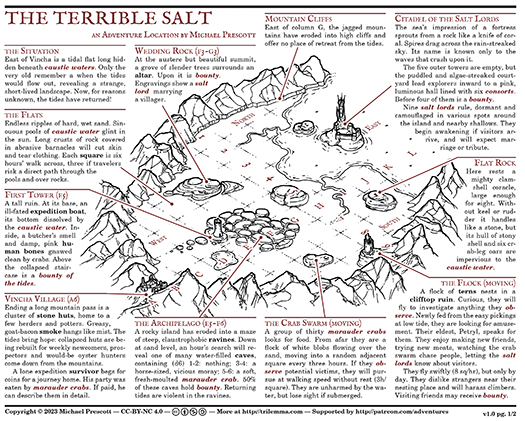
For a generation, the tides at Vincha stopped completely. What was once an enormous tidal flat was lost under bitter waters. Now they have returned, and the brave and curious are gathering to see what was hidden under the terrible salt.

This adventure features an enormous tidal flat, miles and miles wide. Adventurers who set out from Vincha have a strange and dangerous land to explore, and will need to learn its rhythms to return with anything valuable.


The Terrible Salt is something of an experiment in tangibility. Unlike many of my adventures, there's no wandering monster table. Instead, the tides and the crab swarm move in defined ways from their starting points.

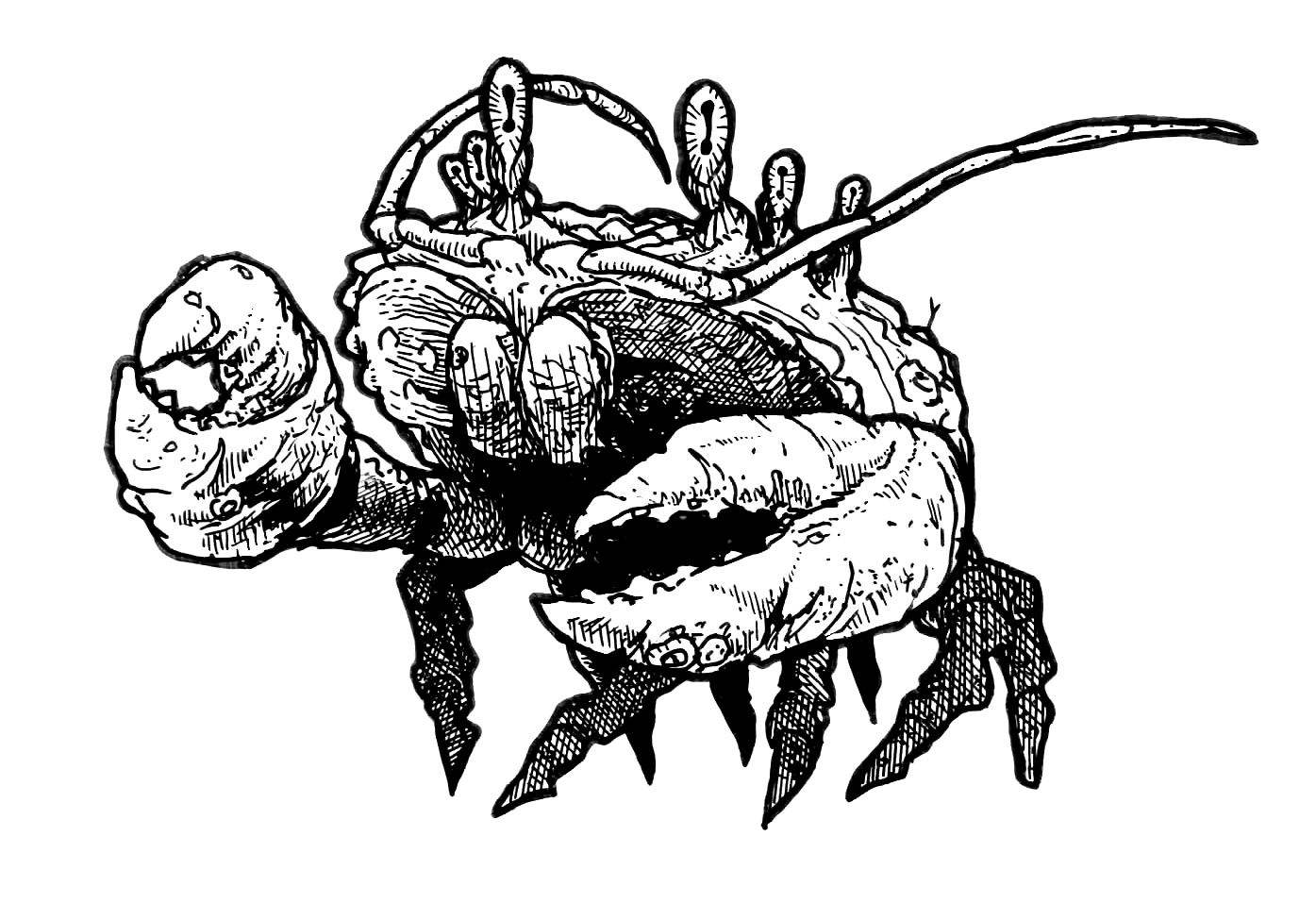
The crab swarm is extremely dangerous. It will outnumber most parties, and unless they have good magic (or horses), it will overrun them and eat them. Avoiding notice is better than trying to flee (since the crabs never stop), but this will require that the players stay aware of their environment.

Being spotted by crabs or trapped by the tides doesn't mean certain death, but players may have to ride out an uncomfortable few days being baked by the sun and freezing at night, all without any drinkable water or means of lighting a fire.

The greatest danger in this scenario is facing both crabs and tides at once, either:

  • the crab swarm comes in at the same time as the tide, and you're fighting waist-high crabs in chest-deep water
  • the party is fleeing the crabs, but is then forced by the tide to shelter on a rocky island before they can shake the pursuit

Fortunately, the map is littered with high spots that should allow the party lots of opportunity to scout out their surroundings and avoid danger. (This scenario contains a compressed version of my take on how far you can see on a hex map.)

As I finished the writing, the coral consorts became my favorite part. The implications of these srange marriages transformed the Salt Lords into something more interesting: an ethically neutral but alien presence in the scenario, inviting the party (or whomever) to take a terrifying step into a different world.

The coral consorts themselves make very interesting maguffins: imagine having to go and talk to a knowledgeable NPC somewhere, but learning that they married the sea and need to be found on the slopes of the Salt Lords' citadel. Good luck!

As always, thank you to my patrons on Patreon, who graciously support this project! Because of your generosity, the text and art pieces are released under CC-BY-NC 4.0, for your own non-commercial use.

* * *

EDIT: Some additional hooks!

Wealthy relatives of the doomed expedition members want their bodies (or heirlooms) reclaimed from wherever they wound up

The players need to contact an NPC to learn something, last known to have retired to Vincha. However, she 'married the sea' and is now somewhere on the slopes of the citadel

The other end of the inland sea (beyond the citadel) is a prosperous area. If a reliable way to cross the sea (possibly with the blessing of the Salt Lords) can be found, an important trade route could open up

Crabs have been attacking Vincha; myths say that they serve the Salt Lords' will, and that when they are happy the crabs are kept at bay

From the top of the citadel, when the clouds part, you can see anywhere in the world (or so say the songs)

Every river for a thousand leagues drains into the flats. The Salt Lords know everything that happens along their lengths; they have the answers you seek.

Too long have the Salt Lords stolen the vulnerable, taking them away to marry the sea. Put an end to it.

On the south shore of the inland sea is a tower. Well, more of a ruin than a tower. It stood watch at the mouth of a pass that reaches all the way to Urchlund.

News of the tides restarting has reached Fair Riot, and it's said a Duke is coming to survey lands that he claims are his. Now, maybe they are and maybe they aren't, but a map of the flats would surely be worth good coin and a Duke's favor besides.

In my nan's time, people used to go out on the flats looking for oysters. She said there was an old well on one of the rocks with water you can drink. That would be an incredibly useful staging area for further exploration.

Oysters out on the flats would be an incredible boon to Vincha, if only it were safe. The baron has a sack of silver for whomever can lure those crabs away and deal with them for good.