Wednesday, 1 October 2014

Gameable Campaign Capital in Exploration/Adventure Campaigns

Bear with me while I muse on a few things I'm trying to sort out. All I'm really trying to do here is label an idea, so I can refer to it later - this is first in a short series.

Campaign Capital

Emily Care Boss came up with a useful term, Story Capital, as a label for the way that as a campaign progresses, fictional elements like player deeds, NPCs, nations, a favorite tavern - whatever - become laden with meaning and emotional investment.

For now I'm going to use the term 'campaign capital', because I'm looking at this all through the lens of exploration/adventure games rather than story games or character-driven games, but I mean more or less the same thing.

Now, I want to take about gameable campaign capital, meaning accumulated capital that can provide fodder for ongoing play.

This leads to a sort of spectrum: campaign capital from least gameable to most gameable:

1. Fondly-Remembered Deeds (aka Remember that Awesome Thing We Did?)

This type is common in linear dungeons and travel-intensive quests. Challenges were overcome, Bargle died and got left behind, great battles were fought. It's awesome, and all in the rear-view mirror.

It's not really relevant to ongoing play because it's four hundred leagues back, and anyways why would we go back to that dungeon we collapsed?  Still, remember when Garridor rolled 20 and critted the lich with his lantern?  That was awesome.

2. GM-Initiated Recurrence (aka Boba Fett! Where?!)

At this level, the GM is bringing things back into play.

Actually, you've got to go back to Zoundheim all because the lich's phylactery was smuggled out by those death cultists you never took care of.  Then it turns out they were the ones who hired you in the first place.

The campaign capital gets reused, and now it's even more awesome - the little groove in your memories gets dug a little deeper.

Lasting curses and injuries inflicted by enemies also belong in this bucket.

3. Player Consideration (aka Bring More Bloody Arrows From Now On)

At this level, the players are aware that things come back into play, and realize that they're worth preparing for.

If the GM has made a recurring threat of harpies, the players may not be seeking out or avoiding harpies - that's in the GM's hands (or the hands of the random encounter table) - but they've figured out that it's a good idea for everyone to have a ranged weapon.

This isn't an exciting example, but play is being shaped by the mere memory, the threat of flying monsters.

For something to quality as this level, it's got to be the players that are bringing it back into play. This is important - not because collaboration is magical or anything like that - but because there are more players than GMs. The more people around the table that can bring something back into the game, the more gameable that thing is.

4. Hard-Won Assets and Options (aka Let's Introduce This Guy To Boba Fett)

This is player-initiated recurrence.  Elements at this level are both useful and worthwhile for players to bring back into play, and they have the means to do it (perhaps at some cost).

Maybe it's allies, maybe it's just a shit sandwich they've figured out how to serve to someone else.  Either way, it's a tool that they control (or can influence).


(This taxonomy is 100% complete and authoritative, and I didn't just make it up right now.)

Okay, So What?

Yes, good question. After all, in urban intrigue or investigation games, player-initiated recurrence is so common you don't even notice it. Your bookie is threatening to beat you up, you can get in touch with him any time you want by phoning him. It's trivial.

Right now I'm thinking a lot about exploration/adventure based play, and I notice in many cases that hard-won assets and options accumulate a lot more slowly.  Part of it is that travel is so difficult (which is why you need explorers and adventurers in the first place!), so hard-won assets are often far away.

You met the queen and you made friends, for instance, but when the harpies are attacking, the Queen and her honor guard are forty miles away where they can't help you.

In adventure games, the usual hard-won asset is character advancement - more hit points, spells, and dish out way more damage with their haul of magical weapons.  But these rarely bring the history of the game back into the present.  Sure you have a +3 sword, but after three adventures it rarely matters where you got it from.

This is what I'm currently noodling on - what are good ways for exploration/adventure games to quickly build gameable campaign capital?

My ideas right now revolve around patterns of clues, the value of knowledge, and fiction-connected advancement. More soon!

The Necromancers' Wish


Here's adventure number twelve, The Necomancers' Wish!

An ancient mine that one yielded a strange and magical pigment, now used by a tribe of beastly goblins as a tomb for their necomancer-lords. Over the centuries, the spirits interred there have accumulated into a potent ancestral host, who have bequeathed a weird and transformative power upon their successor..


The theme for this adventure is transformation, generally involuntary - sometimes harmless, and sometimes not.

The Necromancers' Wish is meant to be placed in your campaign near a wilderness or desert: just beyond the last settlement is a series of caves embedded in a cliff.  Smoke has been seen coming from the cliffs, as has happened on many summer mornings.

But this time, there's a strange disquiet in the town, and those who can sense such things believe it's an omen of bad things to come.

Map Art

Like the adventure itself, the map art is released under the cc-by-nc license.  Have fun with it!

Mines of the Ricalu

Thanks again to everyone who's been supporting my adventures on Patreon!

Thursday, 18 September 2014

A Metric for Campaign Lethality

I present the milliwhack.

This is a measure of the rate at which characters become involuntarily unplayable (through non-resurrected death, crippling, permanent incapacity, concept-destroying transformation, maiming, reduction to idiocy or insanity, going permanently MIA, left for dead as the mind-controlled thrall of an Illithid, campaign-ending TPKs, etc.)

A campaign's milliwhack (mW) rating is calculated as follows:

1. Add up the number of involuntary-unplayable events (usually character deaths, but see above).
2. Divide by the number of sessions in the campaign.
3. Divide by the average number of players per session.
4. Multiply by 1000.

For example:

I played about three years of bi-weekly, Paizo adventure path 3.5e and in that time we had two TPKs and perhaps two PC deaths in the interim. Call that 60 sessions with a party of 4-5 (so, 9 unrecoverable deaths) so that play style rates 33 milliwhacks.

11 deaths / 60 sessions / 4.5 players-per-session * 1000 = 41 mW

In four one-sessions games of four-player Fiasco, I've seen maybe two deaths (both mine). So that play style rates 125 milliwhacks.

2 deaths / 4 sessions / 4 players-per-session * 1000 = 125 mW


Tuesday, 26 August 2014

Dirty Hex Crawl


In which I propose a campaign structure inspired by John Wick's Dirty Dungeons!

Home on the Range

West Marches style, play starts out with a single explored hex (perhaps a 30-mile hex, it doesn't matter much), and a safe community where the party starts and ends all of their adventures.

Play starts off like Dirty Dungeons. To recap:
  1. Players decide what the adventure is, by pretending they've researched it extensively in the town's library, wizard's tower or tavern, and explaining what they've learned.
  2. They take turns describing the threats of the dungeon.
  3. Minor threats earn them a bonus die, and major threats earn them two. These all go into a pool.
During the adventure, players can use the bonus dice to help themselves out with rolls.  (The precise mechanic depends on what game you're playing, it could be Advantage in D&D 5e, or a +1 forward in Dungeon World.)

For every five minutes they spend planning, the GM can introduce a twist - their information is out of date

The GM has the job of stitching this stuff together on the fly, which isn't for the faint of heart but is great fun.

When the adventurers get to the prize they're after, whatever that is, they can use the bonus dice to improve the quality of the treasure.  (Again, this will depend on what game you're playing.)

Dirty Journeys

When the players want to do it all again, there's a problem: they've exhausted the adventure potential of the region they've explored.  They need to explore!

This works exactly like Dirty Dungeons, except:
  • For every four challenges they create, their journey is considered to delve into one new hex.
  • The party needs to bring survival supplies: rations and so on.
  • Loot (and there's always loot) is incidental. The real payoff is that each hex ventured into reveals a potential adventure location the players can now research.
Now, the players can return to plundering with more Dirty Dungeon missions.  The difference is that any travel through the new hexes involves (at the GM's discretion) the challenges that were established, if they weren't somehow defeated during exploration.

These challenges do not come with bonus dice!  They just cause problems.  In fact, the GM is free to use twists to develop them further - perhaps bandits move into the home hex, or expand their operations, or their bandit shaman summons something nasty.  (In Dungeon World parlance, they've become a Front.)


Dirty Quests

If the problems encountered during exploration become too awful to ignore, the players can Quest to deal with them once and for all.  Perhaps the bandits need to be driven

This, too, is handled exactly like a Dirty Dungeon - the players design the bandit stronghold (or whatever) in the same way they'd design any other adventure: the players contribute challenges in exchange for bonus dice, and the GM adds any challenges that the party has to travel through.

Bonus dice can be pulled down for advantages, as usual.  Loot is incidental to the situation, rather than the goal, and bonus dice are converted directly to XP if the quest is completed. (Though at a lower rate than loot - this is after all a plundering game!)

Other Details

There's probably lots more that can be done with this - two things that come to mind are terrain and settlements.

If the GM is using journey twists to create durable terrain problems ("As you reach the end of the mud flats, you see a mountain range rising up to blue heights and white-dotted peaks.") that force players to move laterally.  Particular quests might involve trying to find secret mountain passes, or establishing relationships with communities that could provide guides.

And speaking of communities, while they may be wary at first, parties that prove themselves by accomplishing useful Dirty Quests might be able to establish new places to adventure from, cutting journey times (and dangers) significantly.

What the..

This will of course seem like a weirdly hippie way to plan a campaign, but it's definitely worth a try if you have players who are as stuffed full of ideas as the folks in my home group.  The player investment I got from playing a single Dirty Dungeon really surprised me, and as GM, I didn't in the least feel creatively alienated or anything like that.

I'm curious to see what would come of something like this. Send me your ideas!


Sunday, 24 August 2014

Though Flesh be Vast

Here's the adventure to go along with yesterday's map preview.  This one started out with me wondering what it would be like if a dungeon were viewed by under-worlders the way we see the proverbial mountain-top monastery.  Remote, inaccessible, spiritual places.

Deep in the ground is the world of the dradkin, but with so little sunlight, they are dependent on scarce food resources. Starvation is a constant threat.  The cult of Inceraugh prophecies that one day their great under-good will show them a path to the surface, a fabled place where fat animals blunder about, grazing on a never-ending crop of lush plants that sprouts from every surface.


This adventure is potentially quite dangerous, because the dradkin are so numerous. Their society is breaking into factions, but the party will have to be clever to find and make use of them - or else be polite and generous enough to parlay their way into some hospitality. For now, at least, Incerat operates cohesively, so clumsy or ill-prepared attacks will be provoke punitive counter-attacks.

The rulers will be hard pressed to keep this up, however - the ritual avatar feedings must continue at all costs, and if Incerat's pious warriors are busy mounting a defense, the slave pens will soon be emptied.

Much of Incerat is lit (at least dimly), but consider being careful about PC light sources. If they are guests of the dradkin, they could easily become utterly dependent on their hosts just to get around.

Edit: here's a rainbow-tinted map that uses color to indicate depth beneath the surface.

Note on Power Levels

If you're using a system with a flatter power curve (e.g. Burning Wheel, Dungeon World, World of Dungeons), the threats as described will probably be ample. For established D&D characters, the pious warriors should be quite capable (e.g. 4-7th level fighters), with the fleshpriests having several levels of evil clerical powers in addition to the listed dradkin rituals.

Maps and Illustrations


Thanks again to everyone who's been supporting my adventures on Patreon!

Though Flesh Be Vast - Map Preview

I'm about to release an adventure for August, but while I'm still wrangling with the text, here's a preview of the map.


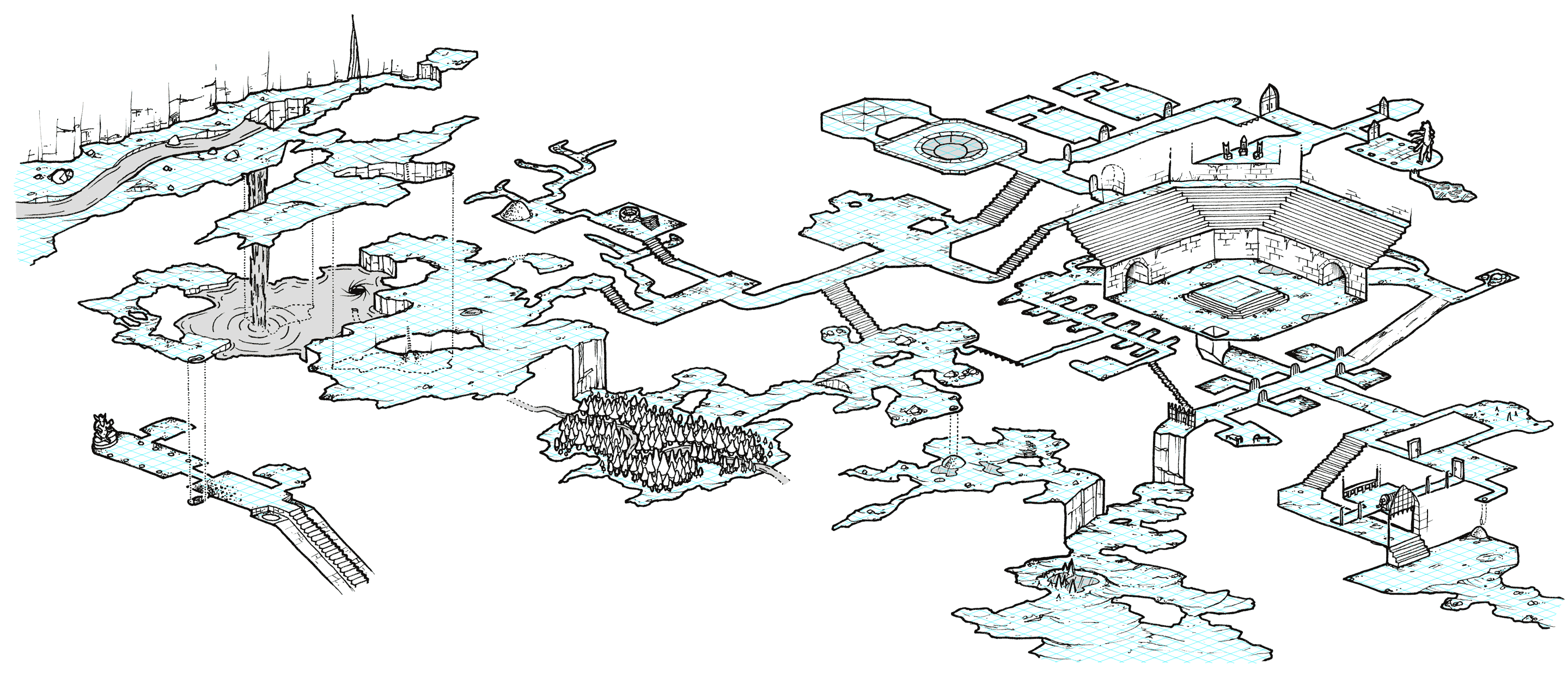
This one's a little different, it's a two-page map spread.  A series of natural caverns gives way to an underground settlement, with roads that extend into underworld areas beyond.

I'm experimenting with the use of old-school style blues grid lines to convey the scale. I'd be curious to hear they're useful or just distracting.

Saturday, 2 August 2014

Making Circular Rooms on Isometric Maps

Once upon a time there was a wizard who was forced to work in a rectangular laboratory where the feng shui was all wrong and magical eddies formed in the corners and besides they were kinda dark which reminded him of the way his homunculus would go off and sulk when the wizard wouldn't let him do the important bits and it blew his concentration and none of his rituals or traps or evil plans came to anything so when the party showed up he wasn't even there for the boss fight and it was this huge anti-climax and everyone said the campaign sucked anyway and it turned into this huge nasty thread on reddit and everybody started playing story games instead.

Dungeons need round rooms.

Unfortunately, round rooms are tricky to draw on isometric (or axonometric) paper. With a top-down map you can easily use a compass, trace a quarter or shot glass or whatever.  I recommend this - I like to think I can draw and apparently even I can't free-hand a small circle very well:

I suck - anyone have a shot glass?
On an isometric graph, it gets even trickier, because the circle is foreshortened into an oval. But what sort of oval?

I find it helpful to make guide-marks.

The guide-marks in the four cardinal compass directions are easy enough to work out: if you have a circle with a three-square radius, you just count three squares north, east, south and west, leaving a guide-mark at each of the four spots.

But how wide to make the oval?  How tall?  The red and blue ovals are two alternatives that pass through the four guide-marks.  The red circle isn't bad, but it's not quite right.


Fortunately, we can work out the diagonal distances with a little math.  We know where the northern guide-mark goes, but what about the northeast (or southwest)?  That would tell us how wide to make the circle.  What about the northwest (or southeast)?  That would tell us how tall to make the oval.

Since we're using graph paper, we can use graph coordinates and a tiny bit of math to figure out where the diagonal should go.  The question to ask is this: how far north (or west) does the NE diagonal reach?  The answer is:

coordinate = sin( radians(45) ) * circle radius

sin is a trigonometric function, and the radians function converts an angle in degrees to the same angle in a funky unit called radians.  (Most sin function implementations expect radians.)  These functions are available in both Google Docs Spreadsheets and Excel.

For a radius-3 circle, you should get an answer that rounds to 2.1.

Photoshoppery

If you're using photo-editing software like Photoshop or Gimp, this is the only measurement you need.  (If you don't like doing calculations math, I'll provide a handy table for you, below.) Measuring this out on the graph paper looks like this:


I measured toward the southeast, but any direction would have done just as well.  The point where the dotted lines cross is also a point on the circle.  In your editing software, draw an oval that goes through all five points.

This isn't a Photoshop tutorial, but briefly: use the oval tool set to 'path' mode.  Start at the circle's center, click and drag.  Then hold down the Alt key to force the oval to be centered on the starting point.  Drag around until the oval you're creating passes through all five points, then release.  Use the 'stroke path' command to turn your path into a usable outline.

It should look like this:


The Traditional Way

If you're drawing a map by hand on graph paper, you'll probably need more guides that this.  As a reminder, guides can be drawn in any direction - here I've added the 45-degree diagonal reaching to the northeast:


We've drawn diagonals at 45-degree increments, so for the next level we'll cut that in half: 22.5 degrees.

We need a bit more math. I simplified before, because the north and east coordinates for a 45-degree diagonal are the same, but they won't be for our next set of diagonals.  The coordinates are:

coordinate 1 = sin ( radians( angle ) ) * radius
coordinate 2 = cos ( radians( angle ) ) * radius

For a radius-3 circle, our two new coordinates are: 1.1 and 2.8.  Mark your three coordinates (1.1, 2.1, and 2.8) on each of the four axes, then draw in guide lines for them, parallel the grid lines on your paper.


Use a ruler to make the guides nice and straight or the inaccuracies will add up and your circle will suck, and we'll be back to sulking homonculi all over again.

Admittedly it looks a bit intense, but it's fairly straight forward once you try it.  But what the hell is it for?  It makes more sense once you visualize your circle in there, and how it passes through the guide intersection points:


Rendering the Circle

You're now ready to pencil in your circle.  While you're doing this, there's one last bit of information that will help you: the angle of the curve at various points.  These are called the tangents (a tangent is a line that just touches a curve).

The cardinal tangents are easy to work out: they follow the grid lines:


The 45-degree diagonal tangents are also easy to work out - they're horizontal and vertical lines on your paper:

The Final Strokes

Now, since you're doing this traditionally, you've got no choice but to extrapolate from your guides and hand-draw in the curves.  This usually takes me a couple of tries for each segment, so I use a light touch and keep an eraser handy, but we have plenty of support from the all of the guides we've built up:


Do your circle pencil, of course, only going over it in ink when you're happy with your pencil version. The finished product should hopefully look something like this:


All ready for some magical rituals!

That Chart I Mentioned

If you don't have a calculator handy, you can use this chart:


If your wizard needs a lab bigger than 32 grid squares across, she'll have to use the equations. Comes with the territory.

Circles on the Brain

Of course, there's a reason I'm obsessing about circles. Once you know how to do a circle, you can use portions of circles to make all sorts of interesting things.

Here's the the start of a map I'm working on for an upcoming adventure, the hull of a mighty ark:


This has five layers of semicircles at each end of the ark.. which took a little while.

Thanks again to everyone who's been supporting my adventures on Patreon!